Build a JSON API in Agentica with Bond and agentica-db
· tutorial, bond, agentica-db, web
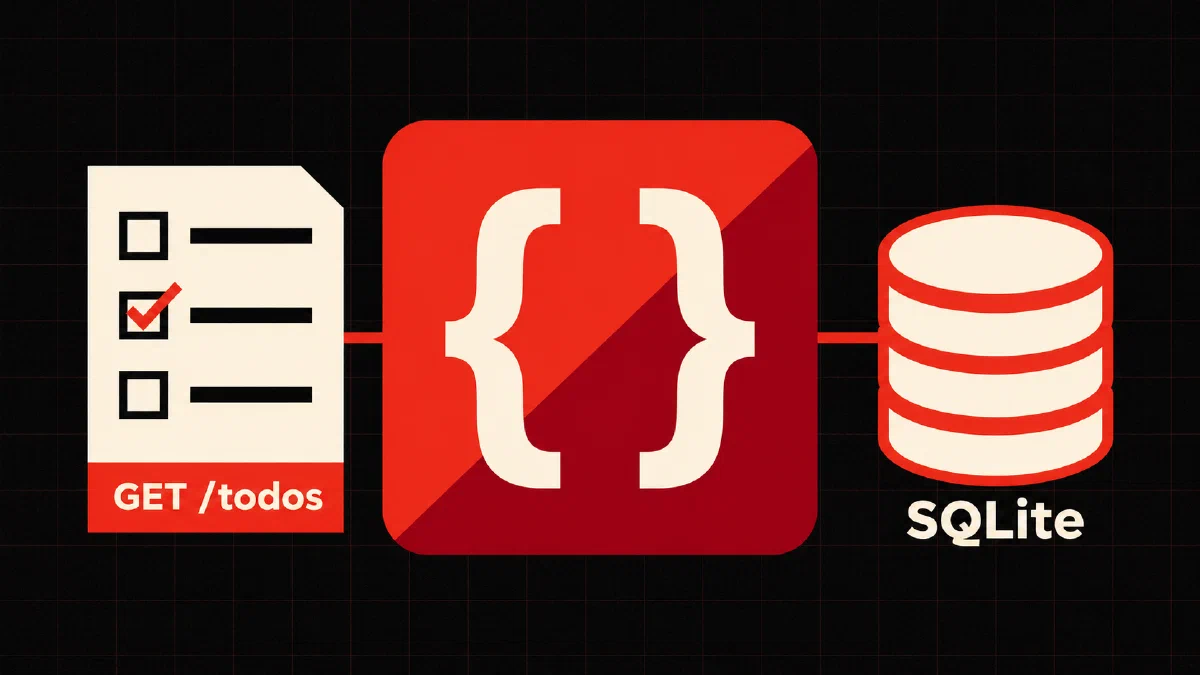
This tutorial builds a small JSON API in Agentica, from an empty folder to a server that you can call with curl. The API manages a todo list: list, get, create, update and delete. It uses Bond, a small web framework, and agentica-db, a database package, with SQLite.
You will see JSON in and out, routes with path params, a filter that checks an API key, validation that answers 422, and a test. The whole program is one file of about 110 lines. The code comes in pieces, in the order of the file, so pasting the pieces one after another gives the file. The last section has it in one block, ready to copy and run.
Everything here ran on Agentica 0.34.1, Bond 0.14.0 and agentica-db 0.13.0. You need Agentica on your PATH, the libsqlite3 library (the package libsqlite3-0 on Debian and Ubuntu) and a C compiler. The compiler builds the native SQLite driver the first time the program runs. Without one, agentica-db prints a warning and uses a slower driver.
1. The project #
Make a folder with an agentica.toml. The manifest has the name of the project and one style setting, which asks for a blank line after each end, as in the code below.
mkdir todos && cd todosname = "todos"
[style]
blank_line_after_end = trueAdd the two packages. Each command writes the dependency in agentica.toml, writes agentica.lock, and puts the files in deps/:
agentica add bond https://github.com/agentica-lang/bond --tag 0.14.0
agentica add db https://github.com/agentica-lang/agentica-db --tag 0.13.0added bond@0.14.0
added db@0.13.0
added pool@pool-0.1.3 (folder pool)The third line is a package that agentica-db needs for its connection pool. Now the manifest has the dependencies:
name = "todos"

[style]
blank_line_after_end = true
[dependencies]
bond = { git = "https://github.com/agentica-lang/bond", tag = "0.14.0" }
db = { git = "https://github.com/agentica-lang/agentica-db", tag = "0.13.0" }If you write the dependencies by hand instead, run agentica update to write agentica.lock and fetch the files. agentica install puts the files of an existing lock in deps/, for example on a fresh checkout.
2. Imports and constants #
Put the program in a file called todos.agc. It starts with the imports and three constants:
import Bond from "pkg/bond/bond"
import Db from "pkg/db/db"
import DbPool from "pkg/db/db_pool"
import Orm from "pkg/db/orm"
import Sqlite from "pkg/db/sqlite"

API_KEY = "secret"
MAX_TITLE = 80
CREATE_TODOS = (
  "create table if not exists todos " +
  "(id integer primary key, title text not null, done integer not null default 0)"
)
pkg/bond/bond is Bond. pkg/db/db, pkg/db/db_pool, pkg/db/orm and pkg/db/sqlite are four modules of agentica-db: Db runs SQL, DbPool shares connections, Orm reads rows into structs, and Sqlite is the driver.
3. The struct and JSON #
struct Todo
  id: Int = 0
  title: String
  done: Bool = false
end

def todos() -> Orm.Schema[Todo] = Orm.schema("todos", Todo.codec)
A struct is a record with typed fields. Every struct has a .codec that turns it into JSON and back. The same struct is the row of the table: Orm.schema("todos", Todo.codec) ties it to the todos table, with the columns named like the fields.
id and done have defaults, so a client can send {"title": "buy milk"} and the database gives the id.
4. The database #
def open_pool(url: String) -> Result[DbPool.Pool]
  pool = try DbPool.start(DbPool.Options(url: url, drivers: [Sqlite.driver()]))
  try DbPool.with(pool) do |db| Db.execute(db, CREATE_TODOS, []) end

  ok(pool)
end
This opens the database and makes the table. Why a pool? Bond runs each request in its own task, and a database connection belongs to the task that opened it. DbPool.start opens connections in tasks of its own, and DbPool.with lends one to a block of code. The handlers below get the pool and borrow a connection for each request.
Db.execute takes the connection, the SQL and a list of parameters. Each call returns a Result, and try passes an error up to the caller. create table if not exists lets the server start again on an existing file.
5. The routes #
def build(pool: DbPool.Pool) -> Bond.App
  (
    Bond.app()
    |> Bond.before(&Bond.log_request)
    |> Bond.before(&require_key)
    |> Bond.get("/todos", ->(conn) { list(pool, conn) })
    |> Bond.get("/todos/:id", ->(conn) { show(pool, conn) })
    |> Bond.post("/todos", ->(conn) { create(pool, conn) })
    |> Bond.put("/todos/:id", ->(conn) { update(pool, conn) })
    |> Bond.delete("/todos/:id", ->(conn) { remove(pool, conn) })
  )
end

def main() -> Void
  pool = open_pool("sqlite:todos.db").unwrap!
  Bond.run(build(pool), "127.0.0.1", 4567).unwrap!
end
Each Bond.get, Bond.post, Bond.put and Bond.delete takes the app, a path pattern and a handler, and returns a new app. The |> pipe passes the app to each call, so the routes read as one list. A segment that starts with a colon, such as :id, matches one segment of the path.
A handler is a function from a Bond.Conn, which holds the request and the answer, to Result[Bond.Conn]. The app does not hold your state, so each route is a small lambda, ->(conn) { list(pool, conn) }, that has the pool in reach. A function that needs only the conn is passed by name, as &require_key is. Bond.before adds a filter, which is explained in step 6.
Bond.run starts the server and returns when it closes. open_pool and Bond.run both return a Result. In main they use unwrap!, which stops the program with the error if the database cannot be opened or the port is taken.
The handlers are defined below. build, open_pool and main come first because they are the public part of the file: the test in step 10 imports build and open_pool.
6. A filter: the API key #
On its own line, private ends the public part: the functions after it are used only in this file. The first two are the filter and a helper for errors.
private

def require_key(conn: Bond.Conn) -> Result[Bond.Conn]
  return ok(conn) if Bond.request_header(conn, "x-api-key").unwrap_or("") == API_KEY

  ok(failure(conn, 401, "missing or wrong X-Api-Key"))
end

def failure(conn: Bond.Conn, status: Int, message: String) -> Bond.Conn
  Bond.json(conn, status, JSON.from({"error": message})).with(halted: true)
end
A filter is a handler that runs before (or after) the route, and filters run in the order they were added. build adds two: Bond.log_request, which Bond provides and which writes METHOD /path of each request to the server’s stderr, and our own require_key.
require_key reads the x-api-key header. If it is right, the filter returns the conn unchanged and the request goes on. If not, it answers 401, and halted: true tells Bond to stop: the route does not run.
failure is the helper for the errors of our code, which are JSON in the form {"error": "..."}. The errors that Bond answers by itself are plain text: a 404 for a path with no route, a 405 for a wrong method, and a 400 for a body that is not valid. Bond.not_found and Bond.on_error change the 404 and the 500 if you want JSON there too.
The key is a constant here to keep the example short. A real service reads it from the environment.
7. Reading todos #
def list(pool: DbPool.Pool, conn: Bond.Conn) -> Result[Bond.Conn]
  rows = try DbPool.with(pool) do |db| Orm.query(db, todos(), "select id, title, done from todos order by id", []) end
  ok(Bond.json(conn, 200, JSON.from(rows)))
end

def show(pool: DbPool.Pool, conn: Bond.Conn) -> Result[Bond.Conn]
  id = try Bond.param_int(conn, "id")
  found = try DbPool.with(pool) do |db| Orm.find(db, todos(), Db.Value.Int(id)) end
  case found
    some(todo) -> ok(Bond.json_as(conn, 200, Todo.codec, todo))
    none -> ok(failure(conn, 404, "no todo #{id}"))
  end
end
Orm.query runs a select and reads each row into a Todo. Bond.json answers with a JSON.Value, and JSON.from makes one from the list.
Bond.param_int(conn, "id") reads the :id of the route as an Int. A text that is not a number is a 400. Orm.find returns an Optional: some(todo) or none. A case handles both, and a missing todo is a 404 with a JSON error. Bond.json_as encodes a struct with its codec.
If the database fails, the try passes the error up, and Bond answers a plain 500 with the text Internal Server Error. The message goes to the server’s stderr, never to the client.
8. Creating, updating, deleting and validating #
def create(pool: DbPool.Pool, conn: Bond.Conn) -> Result[Bond.Conn]
  input = try Bond.json_body(conn, Todo.codec)
  case valid(input)
    error(e) -> ok(failure(conn, 422, e.message))
    ok(todo) ->
      saved = try DbPool.with(pool) do |db| Orm.insert(db, todos(), todo) end
      ok(Bond.json_as(conn, 201, Todo.codec, saved))
  end
end

def update(pool: DbPool.Pool, conn: Bond.Conn) -> Result[Bond.Conn]
  id = try Bond.param_int(conn, "id")
  input = try Bond.json_body(conn, Todo.codec)
  case valid(input)
    error(e) -> ok(failure(conn, 422, e.message))
    ok(checked) ->
      todo = checked.with(id: id)
      changed = try DbPool.with(pool) do |db| Orm.update(db, todos(), todo) end
      return ok(failure(conn, 404, "no todo #{id}")) if changed == 0

      ok(Bond.json_as(conn, 200, Todo.codec, todo))
  end
end

def remove(pool: DbPool.Pool, conn: Bond.Conn) -> Result[Bond.Conn]
  id = try Bond.param_int(conn, "id")
  removed = try DbPool.with(pool) do |db| Orm.delete(db, todos(), Db.Value.Int(id)) end
  return ok(failure(conn, 404, "no todo #{id}")) if removed == 0

  ok(Bond.text(conn, 204, ""))
end
Bond.json_body(conn, Todo.codec) decodes the body into a Todo. If the body is not JSON, does not fit the struct, or comes without the header content-type: application/json, the try makes the request a 400 with a message, and the handler needs no more code. Orm.insert writes the row and returns it with its new id, and the handler answers 201.
update takes the id from the path, not from the body: checked.with(id: id) makes a copy of the todo with that id. Structs never change, so with always makes a new value. Orm.update returns how many rows it changed, and 0 means no such todo, a 404. Orm.delete returns the number of removed rows too, and on success the answer is 204 with no body.
The last piece is the validation that create and update call:
def valid(todo: Todo) -> Result[Todo]
  title = todo.title.strip
  return error("title must not be empty") if title.empty?
  return error("title must have at most #{MAX_TITLE} characters") if title.size > MAX_TITLE

  ok(todo.with(title: title))
end
valid returns a Result[Todo]: the todo with its title trimmed, or an error with a message. A case in create and update turns an error into a 422, and the message goes into the JSON.
Two kinds of mistakes have two statuses. A body that is not JSON, or has no title, is a 400: Bond refuses it before your code runs. A body that fits the struct but breaks a rule of yours, such as a blank title or one over 80 characters, is a 422.
9. Run it #
Start the server. The first run builds the SQLite driver, so it takes a few seconds. It creates todos.db in the folder.
agentica todos.agcIn another terminal, define a small function so each call is short. It sends the API key and the JSON header, and prints the status after the body:
api() { curl -s -w ' [%{http_code}]\n' -H 'x-api-key: secret' -H 'content-type: application/json' "$@"; }These are the calls and what the server answered:
$ curl -s -w ' [%{http_code}]\n' http://127.0.0.1:4567/todos
{"error":"missing or wrong X-Api-Key"} [401]
$ api http://127.0.0.1:4567/todos
[] [200]
$ api -d '{"title": "buy milk"}' http://127.0.0.1:4567/todos
{"id":1,"title":"buy milk","done":false} [201]
$ api -d '{"title": "write a post", "done": true}' http://127.0.0.1:4567/todos
{"id":2,"title":"write a post","done":true} [201]
$ api http://127.0.0.1:4567/todos
[{"done":false,"id":1,"title":"buy milk"},{"done":true,"id":2,"title":"write a post"}] [200]
$ api http://127.0.0.1:4567/todos/1
{"id":1,"title":"buy milk","done":false} [200]
$ api http://127.0.0.1:4567/todos/99
{"error":"no todo 99"} [404]
$ api -X PUT -d '{"title": "buy oat milk", "done": true}' http://127.0.0.1:4567/todos/1
{"id":1,"title":"buy oat milk","done":true} [200]
$ api -d '{"title": "   "}' http://127.0.0.1:4567/todos
{"error":"title must not be empty"} [422]
$ api -d '{"done": true}' http://127.0.0.1:4567/todos
invalid body: title: expected required field [400]
$ api -X DELETE http://127.0.0.1:4567/todos/2
 [204]
$ api -X DELETE http://127.0.0.1:4567/todos/2
{"error":"no todo 2"} [404]
$ api http://127.0.0.1:4567/todos
[{"done":true,"id":1,"title":"buy oat milk"}] [200]
The first call has no key, so the filter answers 401. A new todo is 201 with its id. The GET of a todo that does not exist is a 404, and so is the second DELETE of the same id. A blank title is a 422 with our message, and a body with no title at all is a 400 from Bond. The server’s terminal shows one line per request, such as GET /todos/99, from the log filter.
In the list, the keys are in alphabetical order. A JSON object has no order, and JSON.from writes them sorted, while Bond.json_as keeps the order of the struct.
10. A test (optional) #
You can stop here. If you want a test, put this in test/todos_test.agc. It is a second file, and agentica test finds it in the test/ folder.
import Todos from "../todos"
import Bond from "pkg/bond/bond"
import Testing from "pkg/bond/testing"
import DbPool from "pkg/db/db_pool"
import HTTP from "std/http"

MILK = "{\"id\":1,\"title\":\"buy milk\",\"done\":false}"

def with_app(body: Fn[Bond.App, Result[Void]]) -> Result[Void]
  pool = try Todos.open_pool("sqlite::memory:")
  result = body.call(Todos.build(pool))
  DbPool.close(pool, 1000)
  result
end

def call(app: Bond.App, method: String, path: String, body: String = "") -> Result[String]
  headers = [
    HTTP.Header(name: "x-api-key", value: "secret"),
    HTTP.Header(name: "content-type", value: "application/json"),
  ]

  response = Testing.request(app, method, path, headers, body)
  text = try Testing.text(response)
  ok("#{response.status} #{text}")
end

def test_creates_and_reads_a_todo() -> Result[Void]
  with_app do |app|
    try Test.eq(call(app, "POST", "/todos", "{\"title\": \"buy milk\"}"), ok("201 #{MILK}"))
    Test.eq(call(app, "GET", "/todos/1"), ok("200 #{MILK}"))
  end
end

def test_refuses_an_empty_title() -> Result[Void]
  with_app do |app|
    Test.eq(call(app, "POST", "/todos", "{\"title\": \" \"}"), ok("422 {\"error\":\"title must not be empty\"}"))
  end
end
Testing.request runs the app in the same process, through the same filters and routes as the server, with no socket. The test imports build and open_pool from ../todos, and gives the app a pool on sqlite::memory:: a private database that lives as long as the pool, so each test starts with an empty table. with_app opens the pool, runs the test body and closes the pool. Without the close, agentica test reports tasks that are still running.
A function named test_... in a *_test.agc file is a test. Test.eq compares two values and returns a Result, so the last one is the result of the test. The first test creates a todo and reads it back. The second checks the 422.
agentica testPASS /home/you/todos/test/todos_test.agc / creates and reads a todo
PASS /home/you/todos/test/todos_test.agc / refuses an empty title
2 passed, 0 failed, 0 skipped, 0 not executed, 0 file errorsEach line shows the full path of the test file, so yours differs from /home/you/todos. The project also passes agentica check, agentica lint and agentica fmt --check.
The whole file #
This is todos.agc in one piece. Save it, run agentica todos.agc, and call it with the curl commands above.
import Bond from "pkg/bond/bond"
import Db from "pkg/db/db"
import DbPool from "pkg/db/db_pool"
import Orm from "pkg/db/orm"
import Sqlite from "pkg/db/sqlite"

API_KEY = "secret"
MAX_TITLE = 80
CREATE_TODOS = (
  "create table if not exists todos " +
  "(id integer primary key, title text not null, done integer not null default 0)"
)

struct Todo
  id: Int = 0
  title: String
  done: Bool = false
end

def todos() -> Orm.Schema[Todo] = Orm.schema("todos", Todo.codec)

def open_pool(url: String) -> Result[DbPool.Pool]
  pool = try DbPool.start(DbPool.Options(url: url, drivers: [Sqlite.driver()]))
  try DbPool.with(pool) do |db| Db.execute(db, CREATE_TODOS, []) end

  ok(pool)
end

def build(pool: DbPool.Pool) -> Bond.App
  (
    Bond.app()
    |> Bond.before(&Bond.log_request)
    |> Bond.before(&require_key)
    |> Bond.get("/todos", ->(conn) { list(pool, conn) })
    |> Bond.get("/todos/:id", ->(conn) { show(pool, conn) })
    |> Bond.post("/todos", ->(conn) { create(pool, conn) })
    |> Bond.put("/todos/:id", ->(conn) { update(pool, conn) })
    |> Bond.delete("/todos/:id", ->(conn) { remove(pool, conn) })
  )
end

def main() -> Void
  pool = open_pool("sqlite:todos.db").unwrap!
  Bond.run(build(pool), "127.0.0.1", 4567).unwrap!
end

private

def require_key(conn: Bond.Conn) -> Result[Bond.Conn]
  return ok(conn) if Bond.request_header(conn, "x-api-key").unwrap_or("") == API_KEY

  ok(failure(conn, 401, "missing or wrong X-Api-Key"))
end

def failure(conn: Bond.Conn, status: Int, message: String) -> Bond.Conn
  Bond.json(conn, status, JSON.from({"error": message})).with(halted: true)
end

def list(pool: DbPool.Pool, conn: Bond.Conn) -> Result[Bond.Conn]
  rows = try DbPool.with(pool) do |db| Orm.query(db, todos(), "select id, title, done from todos order by id", []) end
  ok(Bond.json(conn, 200, JSON.from(rows)))
end

def show(pool: DbPool.Pool, conn: Bond.Conn) -> Result[Bond.Conn]
  id = try Bond.param_int(conn, "id")
  found = try DbPool.with(pool) do |db| Orm.find(db, todos(), Db.Value.Int(id)) end
  case found
    some(todo) -> ok(Bond.json_as(conn, 200, Todo.codec, todo))
    none -> ok(failure(conn, 404, "no todo #{id}"))
  end
end

def create(pool: DbPool.Pool, conn: Bond.Conn) -> Result[Bond.Conn]
  input = try Bond.json_body(conn, Todo.codec)
  case valid(input)
    error(e) -> ok(failure(conn, 422, e.message))
    ok(todo) ->
      saved = try DbPool.with(pool) do |db| Orm.insert(db, todos(), todo) end
      ok(Bond.json_as(conn, 201, Todo.codec, saved))
  end
end

def update(pool: DbPool.Pool, conn: Bond.Conn) -> Result[Bond.Conn]
  id = try Bond.param_int(conn, "id")
  input = try Bond.json_body(conn, Todo.codec)
  case valid(input)
    error(e) -> ok(failure(conn, 422, e.message))
    ok(checked) ->
      todo = checked.with(id: id)
      changed = try DbPool.with(pool) do |db| Orm.update(db, todos(), todo) end
      return ok(failure(conn, 404, "no todo #{id}")) if changed == 0

      ok(Bond.json_as(conn, 200, Todo.codec, todo))
  end
end

def remove(pool: DbPool.Pool, conn: Bond.Conn) -> Result[Bond.Conn]
  id = try Bond.param_int(conn, "id")
  removed = try DbPool.with(pool) do |db| Orm.delete(db, todos(), Db.Value.Int(id)) end
  return ok(failure(conn, 404, "no todo #{id}")) if removed == 0

  ok(Bond.text(conn, 204, ""))
end

def valid(todo: Todo) -> Result[Todo]
  title = todo.title.strip
  return error("title must not be empty") if title.empty?
  return error("title must have at most #{MAX_TITLE} characters") if title.size > MAX_TITLE

  ok(todo.with(title: title))
end
Where to go next #
- Bond has more than this post used: cookies, signed sessions, forms and uploads, static files, streaming and WebSockets. Read the Bond docs.
- agentica-db has a query builder, transactions, migrations, and PostgreSQL and MySQL drivers next to SQLite. Read the agentica-db docs.
- The language docs explain the syntax, types,
Resultandcaseused here. - The Ecosystem page lists the packages and projects around Agentica.