Low level
TUI.Raw is the terminal by hand, for what TUI.run does not cover. Under the view tree is a grid of cells with a back buffer. Every function that can fail gives a Result.
open(body): opens the terminal (full screen, raw input, no cursor), gives the block aScreen, and closes it when the block ends.width(screen),height(screen): the size in cells.clear(screen, style): fills the back buffer with spaces instyle.set_cell(screen, x, y, char, style): one character at columnx, liney(from 0), with the zero-width ones that go on it (combining marks, joiners), at most 32 in all.write(screen, x, y, text, style): text fromx,y; what passes the right edge is cut. Gives the width of the text.present(screen): shows the back buffer; nothing drawn appears before it.set_cursor(screen, x, y),hide_cursor(screen).poll_event(screen),peek_event(screen, timeout_ms): see Events.set_input_mode(screen, mode, mouse),set_output_mode(screen, mode).suspend(screen),resume(screen): give the terminal back to another program (main screen, its own modes) and take it again with the modes it had; draw the whole screen afterresume. Calling either twice changes nothing.render(screen, node, last),diff(old, new),Grid: see View tree.program(backend(screen), app): the loop ofTUI.runon a screen already open; it sets the modes of the app and puts the screen’s own modes back when it ends.backend(screen)is the screen as aTUI.Backend, the record of functions the loop reaches the terminal through.
style may be left out. A loop written by hand with a one-second wait (in TUI.run it is a Sub.Tick):
import TUI from "pkg/tui/tui"

def clock(screen: TUI.Raw.Screen) -> Result[Void]
  while true
    try TUI.Raw.clear(screen)
    _ = try TUI.Raw.write(screen, 0, 0, "#{Time.now_ms() / 1000} s, q quits")
    try TUI.Raw.present(screen)
    case try TUI.Raw.peek_event(screen, 1000)
      some(TUI.Event.Char("q", _)) -> break
      _ -> nil
    end
  end

  ok()
end

def main() -> Void
  case TUI.Raw.open(&clock)
    ok(_) -> puts("bye")
    error(e) -> IO.warn(e.message)
  end
end
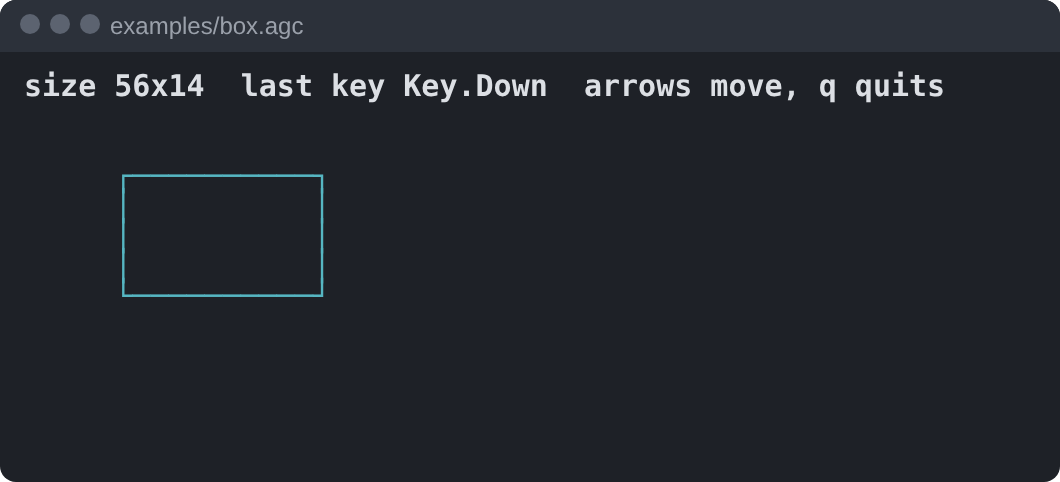
examples/box.agc is a longer loop by hand: a box that moves with the arrow keys or a click, under a line with the size and the last event.
Tasks and locks #
poll_event and peek_event wait in calls of at most 50 ms. Other tasks run while they wait, and may draw: every termbox2 call holds one lock. Closing the screen (the end of the open block) ends a wait with an error.
A call with a screen after it is closed stops the task with RUNTIME-NATIVE-CLOSED. A close that lands between a wait’s check that the screen is open and its next 50 ms call does the same, instead of giving the error.
Limits #
- One terminal per process: termbox2 keeps global state, so a second
openwhile one is open is an error. - While the screen is open the process has a UTF-8
LC_CTYPE(termbox2 needs it to measure characters); the close puts the old one back. - Not bound:
tb_printf, output modes 216 and grayscale.